Heliotropismus, Klub Portitz
Group exhibition
Elfin Açar is a visual artist who primarily works in the field of painting. At the centre of her artistic practice are the relationships between identity, memory, time, place, and women’s experiences. For Açar, painting is not merely a means of producing images, but a field through which she explores how identity, experience, and remembering take shape and transform over time. She extends her painting practice through textile-based methods such as weaving and embroidery, exploring the possibilities of surface, material, and artistic process.
In Açar’s work, identity does not appear as something fixed and complete, but as a process that changes and is continually reconfigured over time. The past is not understood as a time left behind; it remains in contact with the present, is remembered anew, and transforms with each act of remembering. This tension between past and present becomes visible in the layers of her paintings and in the process of making. Different moments in time meet on the same surface; images, forms, and traces are transformed and become part of the experience of the present.
Personal experience and biographical traces open onto different layers of memory within Açar’s work. The personal encounters the traces of other stories and other times. This encounter expands particularly through women’s experiences and the ways in which their stories are passed on. Açar is interested in women’s stories that exist beyond official histories and are transmitted from generation to generation through everyday life. These stories are carried not only through language, but also through the body, the hand, repetition, labour, and making. The repetition of a movement, the continuation of a form of handwork, or a trace left on a surface can itself become a form of storytelling.
For this reason, textile, weaving, and embroidery are not independent disciplines within Açar’s practice, but extensions of her painting, expanding its material and conceptual boundaries. Thread, fabric, stitch, and weave become means of exploring how stories are carried, repeated, and transformed over time. Rather than simply representing a story, material carries the very form through which that story is transmitted.
The process of making holds an inherent meaning in Açar’s work. The application, covering, withdrawal, and reworking of paint, together with weaving, stitching, and repetition, form part of the work’s becoming. The slowness of handwork, chance, control, and the resistance of the material encounter one another within this process. Time spent making accumulates on the surface; some traces remain visible while others disappear beneath successive layers. Yet nothing that disappears is completely lost. Story becomes material, material becomes time, and time becomes a trace on the surface.
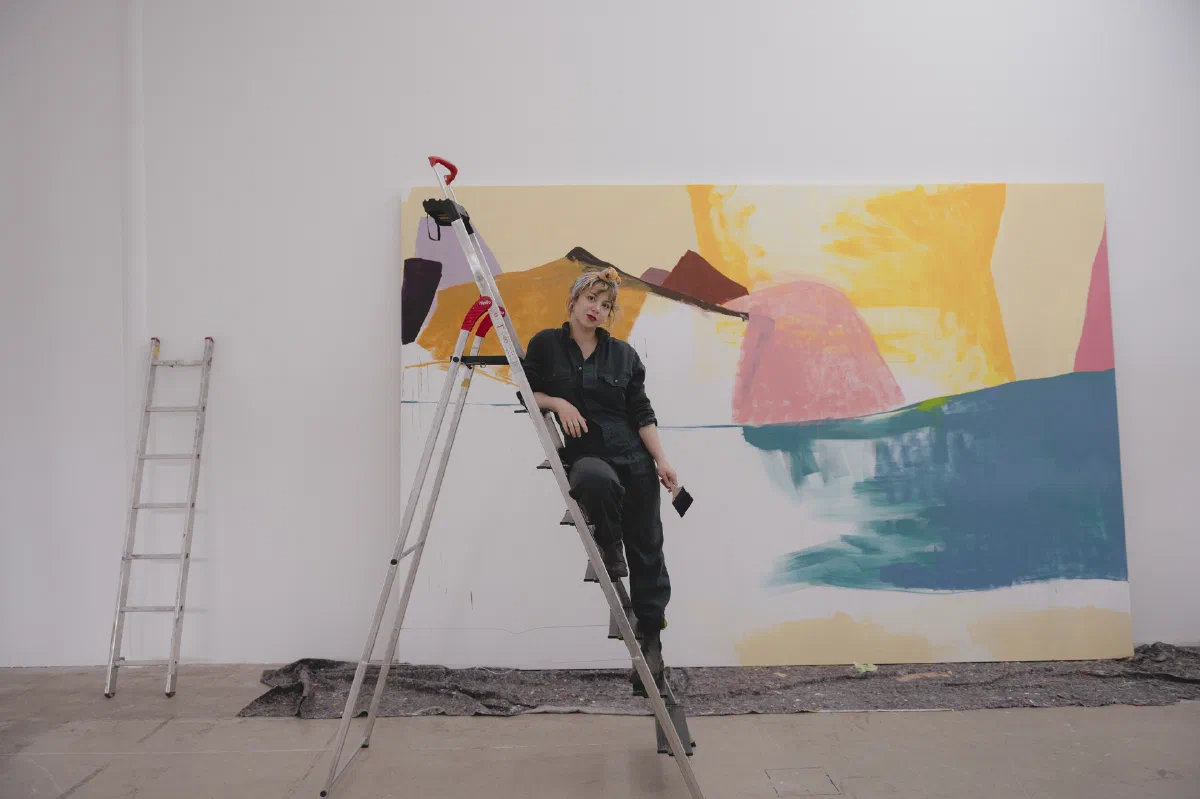
Açar’s paintings move between abstraction and landscape. Landscape is not a direct representation of a specific geography, but rather the transformed image of a place retained in memory over time. Geometric forms, expansive fields of colour, lines, and layers do not describe a particular place; instead, they explore how a place is remembered and reconstructed within memory. Space therefore moves beyond the physical location and becomes a mental and emotional terrain.
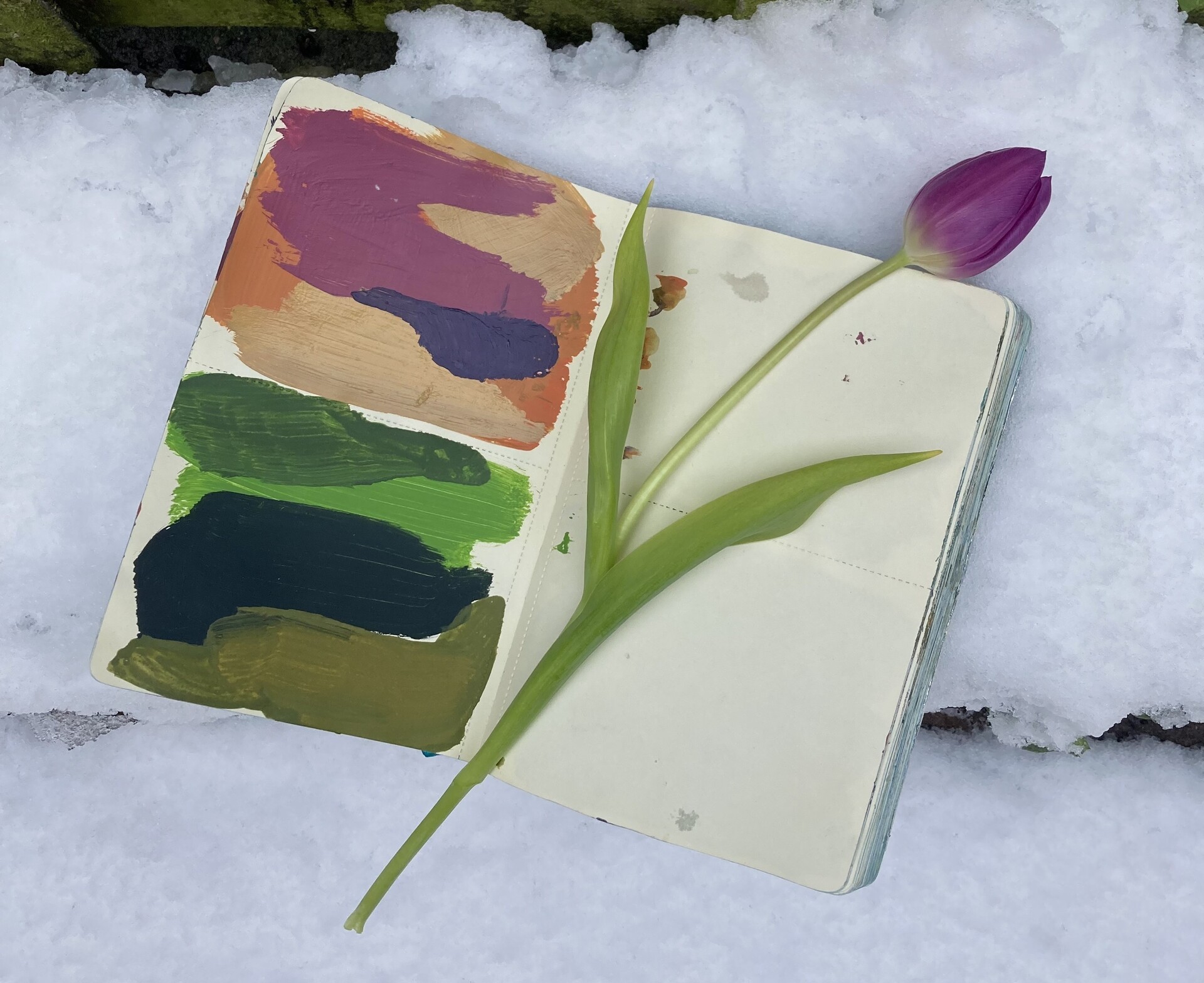
An important element of this painterly language is Açar’s distinctive colour palette. Colours are not understood as individual symbols, but exist through the relationships they establish with one another. Encounters, transitions, intensities, and tensions come together to form a colour language characteristic of Açar’s work. Her combinations of colour create their own rhythm and poetic narrative within the painting; at times carrying the memory of a landscape, at times the vibration of an emotion, or the trace of an image retained in the mind. Colour thus becomes more than a visual element of the painting—it becomes a carrier of the narrative itself.
Açar’s painting practice also extends into space and architecture. Particularly in her large-scale works, the painting ceases to function as an independent object on the wall and enters into a relationship with its architectural surroundings. The dimensions of the wall, light, surrounding space, scale, and the movement of the viewer become part of the experience of the work. Architecture is no longer a neutral frame, but an active element that shapes the perception of the painting.
Within this relationship, the body mediates between painting and space. The viewer approaches the work, moves away, enters into the proximity of the surface, and attempts to grasp the whole. As scale, movement, and distance change, so does the experience of the painting. The body also enters Açar’s work as a carrier of women’s experiences, memories, and stories.
In Elfin Açar’s practice, identity, memory, time, and space are not separate concepts. They exist as layers that touch, transform, and continually acquire new meaning on the surface. Açar’s works do not offer definitive narratives; instead, they create open fields. Past and present, the personal and the collective, body and space, image and material encounter one another on the same surface.
For Açar, painting is therefore less a way of reproducing the past than a means of making visible how identity, experience, and remembering are continually reconstructed. Painting is not an end result within her practice, but a field of inquiry—a poetic space in which stories, time, the body, and memory are continuously rewritten on the surface.